
June 30, 2026
6 Min. Read
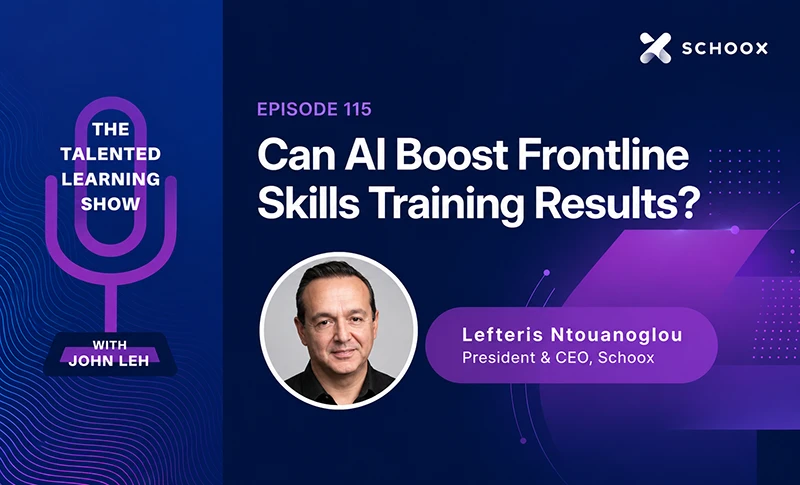
Frontline workers make up nearly 80% of the global workforce. They’re also the hardest workforce segment to train at scale because turnover is high, the work doesn’t happen at a desk, and most learning technology wasn’t built with them in mind.
That’s the territory Schoox CEO and Founder Lefteris Ntouanoglou covered in a recent conversation with John Leh, CEO and Lead Analyst at Talented Learning, one of the most respected independent research firms in the enterprise learning space. Their discussion in Episode 115 of The Talented Learning Show traces how the Schoox vision for connecting learning, skills, and business outcomes has finally become technically possible, why most organizations get stuck in the wrong place on skills, and what a fully integrated approach to frontline training looks like in practice.
How has Schoox’s approach to learning evolved over the years?
Schoox started as a learning platform. Over time, Lefteris told Leh, it grew into something broader: a system built to connect learning, development, and business growth into one loop. That had been the company’s vision from the start, even before the technology existed to deliver on it.
“Honestly, that was our vision from the very beginning. We had no idea back then how to do it. It was 10 years ago, but this is how it should be anyway.”
— Lefteris Ntouanoglou, CEO & Founder, Schoox
For years, getting there meant stitching together disconnected pieces in what Lefteris described as, at times, “a Frankenstein approach.” Other vendors used AI to bolt on new features. Schoox saw a different opportunity: a way to finally connect everything the way it always should have worked.
“AI just made it possible at the end of the day. Now we can connect all the dots with AI in a way the market and the world never thought is possible.”
— Lefteris Ntouanoglou, CEO & Founder, Schoox
Why isn’t connecting learning systems enough on its own?
Most L&D ecosystems already pass data between applications. A performance review tool that shows what training someone completed is one example. Lefteris drew a sharp distinction between that and real integration. Data sharing tells you what happened. Integration means activity in one system actually changes what happens in another.
“If you have a skill assessment with a low score, that should trigger the learning application to recommend the right training to improve your score.”
— Lefteris Ntouanoglou, CEO & Founder, Schoox
That kind of two-way connection across learning, skills, goals, performance reviews, coaching, and business analytics was never achievable across a set of separate, best-of-breed tools. The only way to deliver it, Lefteris argued, is to bring those pieces together in one system.
What’s wrong with how companies approach skills-based learning?
Skills-based learning picked up momentum after the pandemic, as organizations leaned into upskilling and reskilling. But the conversation quickly got consumed by ontologies and taxonomies, including how to categorize diverse skill sets and how to tie competencies to skills. Most organizations are still paralyzed trying to find the right skills framework and map it to jobs.
His reframe: stop starting with the taxonomy. Start with the business metric a specific skill can move, in the context of a job, a brand, and an industry.
“Once you realize what business metric a specific skill — within the context of the job and the brand and the industry — can move, you have a very different conversation.”
— Lefteris Ntouanoglou, CEO & Founder, Schoox
The example he gave Leh: training a restaurant server on “communication” as a soft skill means little on its own. But training that same server to upsell more, increase order accuracy, or resolve complaints faster, and tying that to a 3% gain in order accuracy or a 2% gain in customer loyalty, makes the skill conversation concrete. It stops the focus on which taxonomy the skill came from and puts learning teams at the center of operational improvements.
Schoox customers bring messy, overlapping skills data from HR systems, third-party course libraries, and internally built content, often with nearly duplicate skills mapped inconsistently across courses and jobs. Lefteris described the unglamorous work of automatically building equivalency layers across that data and helping admins merge near-duplicate skills as one of the challenges that stops teams from making real progress. It is essential. Without it, skills-based learning doesn’t work, no matter what a vendor claims.
How does the Learning Impact Suite connect training to business outcomes?
Lefteris walked Leh through four layers of the system. First, Schoox builds a business impact profile for a job by mapping which business metrics that role can influence, and which skills and behaviors drive them. From there, the system can model realistic uplift. If the average check size is $9, what does a 5 to 10% improvement look like once it’s scaled across thousands of servers?
Second, the system builds the actual training plan and course content needed to hit that target, accounting for the job, the industry, and the specific behaviors that need to improve. Third, an intelligence layer keeps tracking what’s working after training launches, including what questions employees still have and what gaps persist, and uses that to recommend further training. Fourth, a correlation dashboard measures whether the training actually improved the business metric, compares the result to the original forecast, and recalibrates future predictions accordingly.
“We are trying to make learning meaningful, so it can serve its ultimate purpose.”
— Lefteris Ntouanoglou, CEO & Founder, Schoox
Because the whole loop runs fast, organizations can pilot a training plan with a handful of locations rather than waiting months for field feedback before building a course.
Why focus specifically on frontline organizations?
Lefteris told Leh that Schoox’s product is industry agnostic, but the company’s direct sales focus has stayed deliberately on frontline organizations including restaurants, retail, hospitality, manufacturing, and similar industries where the workforce is large, turnover is high, and very little training investment typically goes toward the people doing the work. Because those organizations often run on thin margins, even a small gain in operational efficiency can make an outsized difference at scale.
Reaching that workforce also means designing for mobile from the ground up, since most frontline employees don’t work from a desk or a company laptop. Schoox built its first native mobile app in 2011, and Lefteris noted the platform still accounts for the practical and legal complexity of training on personal devices, including the ability to restrict or compensate for training completed outside a shift or off a company Wi-Fi network.
That’s the ground Lefteris and Leh cover in Episode 115, and it’s worth hearing in full.
Listen to the full conversation on The Talented Learning Show
Related reading
- Learning Impact Suite: how Schoox connects training investment to forecasted business return
- Schoox named a Lighthouse Tech Award winner for Best Advance in Practical AI and Best Frontline-Focused Solution